After setting rat poison in the kitchen corners, placing gecko traps behind the refrigerator, and spraying insecticide along the edges of the windows, I began my vacation. It was not the most romantic beginning to a journey, but most departures from ordinary life rarely are. Before one travels toward mystery, one must first deal with the minor practicalities of existence: insects, damp corners, forgotten food, electric switches, locked windows, silent rooms. There was something faintly comic about it. A man preparing for solitude begins by declaring war on small, invisible creatures. Perhaps all journeys begin this way, not with courage or revelation, but with the small administrative gestures by which we convince ourselves that life will remain in order while we are gone.
I stood for a moment in the middle of my apartment after finishing everything. The place looked unchanged, yet it had already begun to feel abandoned. The refrigerator hummed with its usual indifference. Somewhere outside, traffic moved along the road with the steady confidence of a city that had no reason to miss anyone. I had the strange feeling that I was not leaving a home but sealing a container of my own habits: the cup near the sink, the shoes by the door, the faint smell of insecticide at the windows, the silence that follows preparation. If a gecko died in my absence, I hoped it would at least understand that nothing personal was intended. Every year, around the same time, I feel the need to disappear. I usually call it travel because that sounds healthier and more respectable. But travel is not always the correct word. Travel suggests curiosity, movement, itinerary, appetite. What I wanted was not quite any of these. I wanted to place distance between myself and the machinery of my own life. I wanted the familiar to become slightly unreal. I wanted to return, if possible, with some part of me rearranged.
This time the impulse carried me to Chiang Khan, a small town along the Mekong River near the Thai–Laos border. The journey itself was ordinary enough: Singapore to Malaysia and then to Bangkok, Bangkok to Loei, then a long drive through the countryside toward the river. Yet ordinary journeys have a way of becoming strange when one is travelling alone. Airports, in particular, are places where people temporarily lose their identities. Airports, security trays, boarding gates, paper cups of coffee, the artificial cold of departure halls. In airports, everyone appears temporarily unclaimed. Men in business shirts sleep with their mouths open. Children drag toys across polished floors. People look at screens announcing cities they may or may not truly reach. For several hours, identity becomes provisional. A passport says one thing. A face says another. The boarding pass, meanwhile, says nothing at all, which is perhaps the most honest position.
The drive from Loei to Chiang Khan felt like a gradual thinning of the world. The roads grew quieter, the buildings lower, the distances between things wider. The countryside passed in fragments: faded shop signs, shrines wrapped in coloured cloth, dogs asleep beneath motorcycles, fields half-conscious in the afternoon heat, electric poles standing at regular intervals like mute witnesses to a forgotten argument. Every few kilometres the road curved, and the world seemed to lose another layer of noise.
The driver spoke little English, and I spoke no Thai worth mentioning, so our silence became the language of the journey. It was not an awkward silence. It had weight and shape. Occasionally he pointed at something outside the window and said a word I could not understand. I nodded as though I did. It is astonishing how far civilization has progressed on the strength of people nodding at things they do not understand. After a while, the inability to explain anything felt oddly liberating. There are journeys where language only gets in the way.
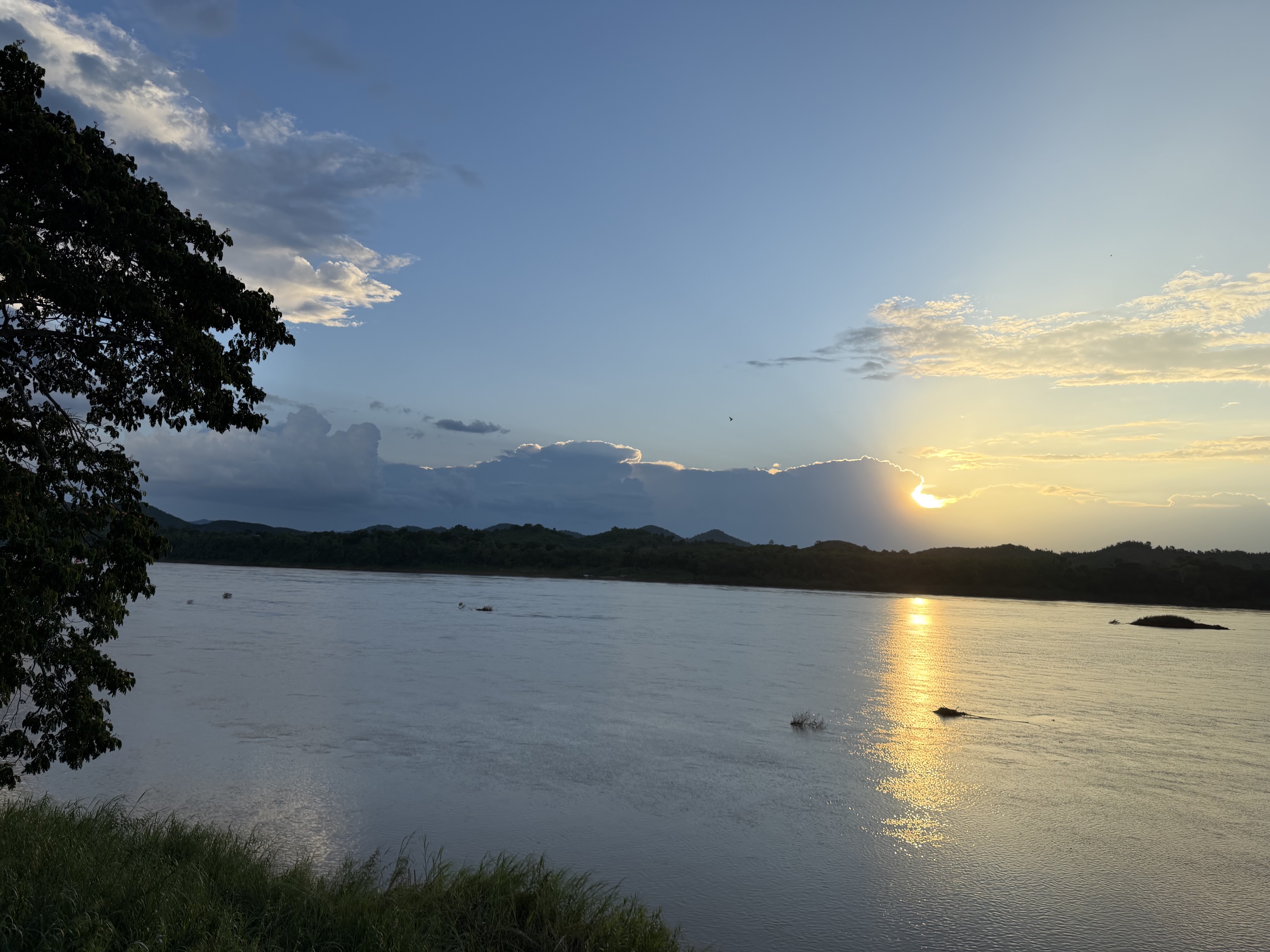
By the time I reached Chiang Khan, evening had settled over the Mekong. My room faced the river, and across the water Laos lay quietly beneath the same fading sky. It was close enough to see, close enough to imagine, close enough to invent. Yet it remained unreachable in the particular way visible things can be unreachable. The river between the two countries was not wide, but it carried a kind of ancient refusal. It accepted boats, rain, reflected lights, dead leaves, perhaps secrets, but it did not accept human certainty. Someone there might be looking across at Thailand with the same mild curiosity, perhaps wondering about the rooms, the roads, the lives arranged on this side of the water. Borders are strange inventions. On a map they appear as lines, but in life they are often rivers, habits, histories, permissions, fears. The Mekong did not seem to care about any of this. It moved slowly through the dark, carrying no passport, belonging to no one. It passed through the night with the calm of something that had watched empires, borders, prayers, hunger, kings, soldiers, lovers, and all arrive with importance and leave with none. Rivers, I thought, must find human paperwork exhausting. Somewhere downstream, a boat engine moved through the dark. Then even that disappeared.
I had not planned much for the trip. That seemed important. Too much planning turns travel into execution, and I wanted the days to retain some authority over me.
I slept badly.
At some point during the night I woke and thought I heard bells. Not loud bells. Small metallic ones, like something tied to a moving body. I sat up and listened. There was only the ceiling fan, the river, and insects knocking themselves against the window glass. They seemed determined to enter, despite the fact that I had recently built an entire domestic policy around keeping their relatives out.
The next morning I took a taxi to Dan Sai.
The town was preparing for Phi Ta Khon.
Before travelling there, I had seen photographs of the festival: bright masks, long noses, crowds, ghosts, costumes made from strips of cloth. But photographs are impatient things. They remove waiting. They remove heat. They remove the smell of food, the boredom before music, the old man adjusting his sandal, the child who cries because the mask is too heavy, the plastic chair beneath the shade, the dust on the road, the silence before drums begin. Photographs also remove the small administrative failures of the human body: sweat, hunger, sore feet, the need to find a toilet at the most spiritually inconvenient moment.
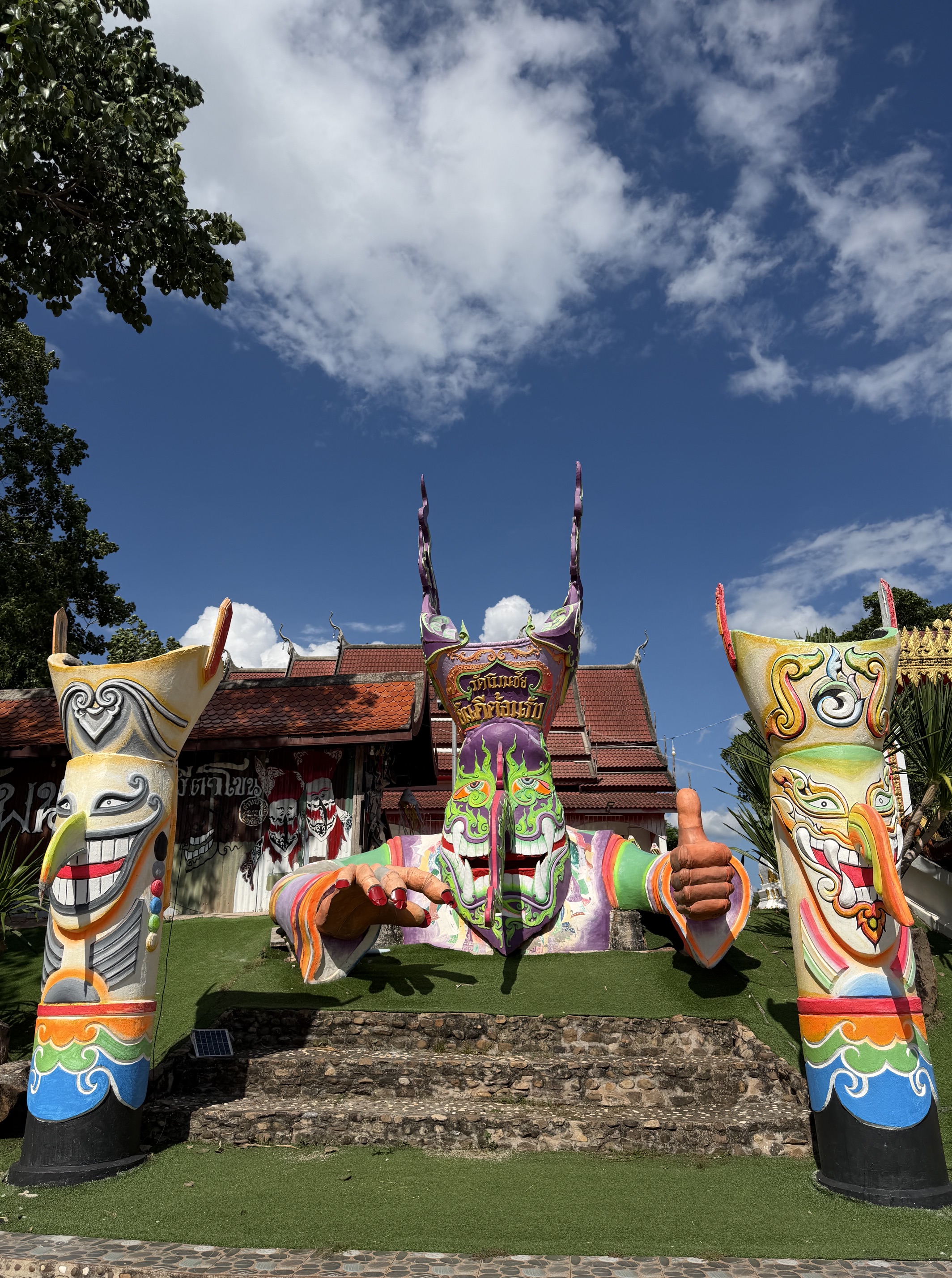
The first mask appeared outside a small shop before I reached the centre of town. It hung beside bottled water and packets of snacks. Its face was painted in red, yellow, and blue, with eyes too wide for comfort and a long nose extending outward like the beak of a bird that had survived from another age. Nobody around it seemed surprised. A boy passed beneath it eating from a plastic bag. A woman stacked goods on a table. A dog slept nearby, its body curved like a comma.
The mask did not look like decoration. It looked like something that had arrived early and was waiting for the rest of the town to remember.
Soon there were more of them. Hanging from beams. Leaning against walls. Resting on motorbikes. Worn by children, teenagers, old men, shopkeepers, boys with shy shoulders, girls laughing behind painted faces. Some masks grinned. Some grimaced. Some looked drunk. Some looked wise. Some had the expression of beings that had seen human life from too great a distance and found it both amusing and sad. A few looked like middle managers after a budget meeting, which is to say, spiritually damaged but still technically functional.
By midday the town had loosened from its ordinary shape.
Drums began somewhere beyond the temple and rolled through the streets like weather. Bells and tin cans tied to costumes made rough metallic sounds. Firecrackers tore small holes in the air. People moved in bright cloth, patched fabric, masks with long noses, wooden swords, painted mouths, exaggerated eyes. The ghosts did not descend from some hidden mountain or emerge from a ruined temple. They bought drinks, checked their phones, adjusted their sandals, laughed with friends, asked for directions, posed for photographs, and then returned to being ghosts. It was reassuring, in a way, to discover that even the supernatural had errands.
This was the first thing that unsettled me: the supernatural had not replaced the ordinary. It had entered it and found a place to sit.
At a food stall, a masked woman turned skewers of grilled chicken while speaking on her mobile phone. Her mask had a wide red mouth and blue teeth. Through the eye holes I could see her real eyes narrowing against the smoke. A few steps away, a boy in a ghost costume bent down to tie his shoelace. His mask tilted forward so far that for a moment it looked as if the ghost itself had become embarrassed by the human inconvenience of shoes.
I watched all this with the cautious attention of someone who has arrived late to a dream already in progress.
Fragments of explanation reached me during the day, never in the form of a single complete story. One person spoke of a prince returning from the forest. Another mentioned spirits who followed him back to the city, disguised among villagers, animals, and unseen beings. Someone else told me about ancestors, guardians, rain, the need to ask the sky for fertility before the land became too dry. Near the temple, I heard the name Phra Upakhut, a monk associated with water, protection, and old ceremonies. Later still, someone described an enormous tree that once blocked sunlight from a city, and an elderly couple who cut it down at the cost of their own lives.
The stories did not fit together neatly. I stopped trying to make them do so.
A festival like this does not seem to come from one source. It grows like a tree whose roots enter different kinds of soil: Buddhist memory, village humour, ancestral fear, rain rituals, fertility, death, mischief, community, tourism, boredom, faith, and the human need to turn terror into something wearable. Each story explained part of it. None explained all of it. The gaps between the stories seemed necessary, like the dark spaces behind the eye holes of the masks. A clean origin would have made the festival smaller. Besides, many things in life suffer once their origin is explained too efficiently. Love, for instance. Or bureaucracy. Or the smell inside hotel corridors.
What mattered was not where the ghosts first came from. What mattered was that every year people still invited them back.
The parade thickened in the afternoon. Bodies pressed closer. Music came from several directions at once. The drums seemed to strike not only the air but the chest, the stomach, the bones. Heat rose from the road. The smell of smoke, sweat, grilled meat, dust, beer, incense, and rainless clouds mixed into a single heavy atmosphere.
The masks danced.
Some danced with skill. Some with deliberate foolishness. Some merely stumbled in circles, shaking bells and laughing. A few moved slowly, almost solemnly, as if they had not come to entertain anyone but to complete some private duty. Wooden swords were raised and swung, not in violence but in teasing, in fertility, in laughter sharpened by old meanings. What would look obscene in another setting seemed here to belong to the grammar of rain and crops, desire and survival. The body was not hidden from ritual. It was dragged into the street, exaggerated, painted red, laughed at, and made sacred through absurdity. There was something generous about this. Modern life asks the body to sit upright, smell acceptable, and respond to email. Dan Sai had given it a wooden sword and told it to negotiate with the sky.
That was when the festival began to change inside me.
Until then I had been watching it as a traveller watches a cultural event: alert, curious, slightly outside it. But as the afternoon passed, the masks began to feel less like objects and more like arguments. They argued with the face. They argued with seriousness. They argued with the clean, polished self I usually carry through airports, offices, hotels, elevators, restaurants, border crossings, emails, introductions.
In daily life, I present a face and call it myself. It is a practical arrangement. The face knows how to behave. It nods at the right time. It hides irritation. It arranges fatigue into politeness. It converts uncertainty into small professional smiles. It says yes when necessary, no when safe, nothing when silence is useful. It is not a false face exactly. But it is not complete. It is more like a document approved after several rounds of internal review.
The Phi Ta Khon masks seemed to suggest that another face exists beneath the face, and perhaps another beneath that. Not all of them are noble. Not all are ugly. Some are ridiculous. Some lonely. Some hungry. Some still children. Some already ghosts.
A boy of about twelve passed in front of me wearing a mask too large for his body. The long nose pointed downward, giving the ghost a melancholy expression, though the colours were bright. At first he stood near the edge of the parade, uncertain, shifting his weight from one foot to the other. Then the drums intensified. Something entered him, or something left him. He began to dance with sudden seriousness, swinging his arms and stamping his feet, bells shaking at his waist. For a few moments, he disappeared completely into the ghost.
Then he stopped, lifted the mask slightly, and looked around to see who had been watching.
That brief gesture stayed with me. The human face emerging beneath the ghost. The child checking whether the world had permitted his transformation.
Near the temple, an old man sat on a plastic chair with his mask resting beside him. His real face was dark, lined, and calm. The mask beside him had a wild grin and enormous eyes. He smoked slowly while the parade moved past, as if he had seen the ghosts come and go too many times to be impressed by them. Now and then someone greeted him. He nodded without rising.
The two faces beside each other seemed less like contrast than continuity. The old man and the ghost. The exhausted body and the painted exaggeration. One temporary, one recurring. I wanted to take a photograph but did not. The act felt too crude. There are moments that refuse to become evidence. They must be allowed to remain unreliable. Also, I suspected the old man would have looked at me with the tired forgiveness reserved for tourists and minor sinners.
Later in the afternoon, clouds gathered but did not break. The sky lowered itself over Dan Sai. The air became thick, expectant. The drums continued.
I found myself in a side street away from the main crowd. A row of masks hung from a wooden beam outside a closed shop, turning slightly in the breeze. Their painted eyes faced the street. For several seconds, perhaps longer, I had the feeling that they were not empty. Not alive exactly, not in the childish sense of objects coming to life. Rather, they seemed to contain attention. Patient, impersonal attention. The kind a river has. The kind the dead might have, if the dead still notice anything at all.
Behind me the parade sounded distant, softened by walls and heat. In front of me the masks turned, one after another, as if listening to a conversation I could not hear.
Then I saw the woman in the white mask.
She stood at the far end of the side street, partly in shadow. Her mask was different from the others. It had no long nose, no comic mouth, no bright colours. It was plain and pale, almost featureless, with two small dark openings where the eyes should be. Her clothes were ordinary: a light shirt, dark trousers, sandals. She did not dance. She did not wave. She did not watch the parade. She seemed to be waiting for something that had not yet entered the street.
I could not tell whether she was young or old.
A motorcycle passed between us. For a moment its engine filled the narrow lane. When it had gone, she was no longer there. I walked to the end of the street and looked into the adjoining lane. There were people there, a stack of plastic crates, a child drinking from a bottle, a man carrying ice. No woman in a white mask.
It would be easy to say she disappeared. That would make the story more dramatic than it deserves. It is more accurate to say that she was present, and then her absence became more vivid than her presence had been. This is often the case with important women, unpaid invoices, and the dead.
For the rest of the day, I kept looking for her.
I did not find her.
The main parade moved toward evening with a kind of joyful exhaustion. Dancers drank water through straws without removing their masks. Children placed ghost faces on the ground while eating noodles. Men laughed too loudly. Bells shook. Loudspeakers cracked. Firecrackers startled birds from a roof. Smoke drifted across the street and briefly erased the lower halves of people’s bodies, so that the masks seemed to float.
The town had become a place where categories no longer held. Monk and ghost. Child and ancestor. Joke and prayer. Fertility and obscenity. Tourism and devotion. Mask and face. Life and afterlife. The divisions that ordinarily make the world manageable had loosened, and something older had entered through the cracks.
I felt no revelation. Revelation is too clean a word. What I felt was a disturbance, as if some internal furniture had been moved while I was not looking.
By night, Dan Sai seemed less like a town hosting a festival and more like a town remembering a dream it had every year. Coloured lights glowed against smoke. The masks moved in and out of brightness. Drums echoed between buildings. People laughed, shouted, danced, filmed, drank, prayed, wandered, waited. A masked figure stood beneath a streetlamp and remained perfectly still while others moved around him. For a few seconds, the stillness frightened me more than the noise.
There is a kind of absurdity in watching ghosts dance under electric wires while tourists take photographs on smartphones. But the absurdity did not make the scene meaningless. It made it more human. The world offers no final explanation for death, desire, suffering, accident, drought, illness, longing, or the simple fact of being born into a body that must one day stop. Yet here, in Dan Sai, people did not appear to be asking for a final explanation. They had chosen something else. They had chosen performance, repetition, laughter, colour, noise. They had chosen to meet the dark not by solving it, but by inviting it into the street and teaching it to dance. It is hard to argue with a philosophy that comes with drums and grilled chicken.
That seemed to me a form of intelligence.
Not intellectual intelligence. Not the kind that arranges ideas into systems and calls the arrangement truth. Something more bodily. More communal. Older than argument. A knowledge carried in drums, costumes, offerings, teasing, sweat, rain, and memory. A knowledge that says fear becomes less absolute when given rhythm. Death becomes less solitary when given a mask. The unseen becomes less hostile when invited, honoured, mocked, fed, and sent away.
The next morning, the ghosts were gone.
Or nearly gone.
Dan Sai had resumed the appearance of an ordinary town. Shutters opened. Motorcycles started. Children rode bicycles through streets that had been crowded the day before. Vendors arranged food. Dogs slept in the same patches of shade. The ground held traces of the previous day: bits of coloured paper, bottle caps, damp ash, a broken strip of cloth, a crushed plastic cup. A few masks remained hanging from walls, but without bodies inside them they looked strangely tired. Even ghosts, it seemed, had working hours.
The disappearance unsettled me more than the festival itself.
Noise can be explained. Crowds can be explained. Costumes can be explained. But the morning after a ritual has its own metaphysics. Something has happened, yet the world insists on continuing as before. A street that held spirits becomes a street again. A boy who was a ghost becomes a boy again. The old man’s painted double returns to storage. The drums stop. Shops open. Life resumes with almost insulting ease.
Perhaps that is why rituals need repetition. One festival cannot defeat disappearance. One parade cannot settle the account between the living and the dead. One mask cannot reveal the self permanently. Everything must be done again next year because nothing human stays solved. The universe, if it keeps accounts, must have a terrible backlog.
I returned to Chiang Khan that afternoon.
The Mekong was still there, moving with the same slow indifference. Across the water, Laos appeared unchanged. The same distance. The same nearness. The same impossibility. I sat by the window and watched the river until the light weakened.
Only then did I notice something on the small table beside my bed.
At first I thought it was a folded receipt or a piece of hotel paper. When I picked it up, I saw that it was a thin strip of painted cloth, red and blue, no longer than my finger. It looked like it had come from one of the costumes. I did not remember bringing it back. It might have stuck to my shoe. It might have fallen from my bag. It might have been placed there by housekeeping for reasons beyond my understanding. None of these explanations satisfied me, though one of them was almost certainly correct. Reality often wins by being boring.
I held the cloth for a while.
It smelled faintly of smoke.
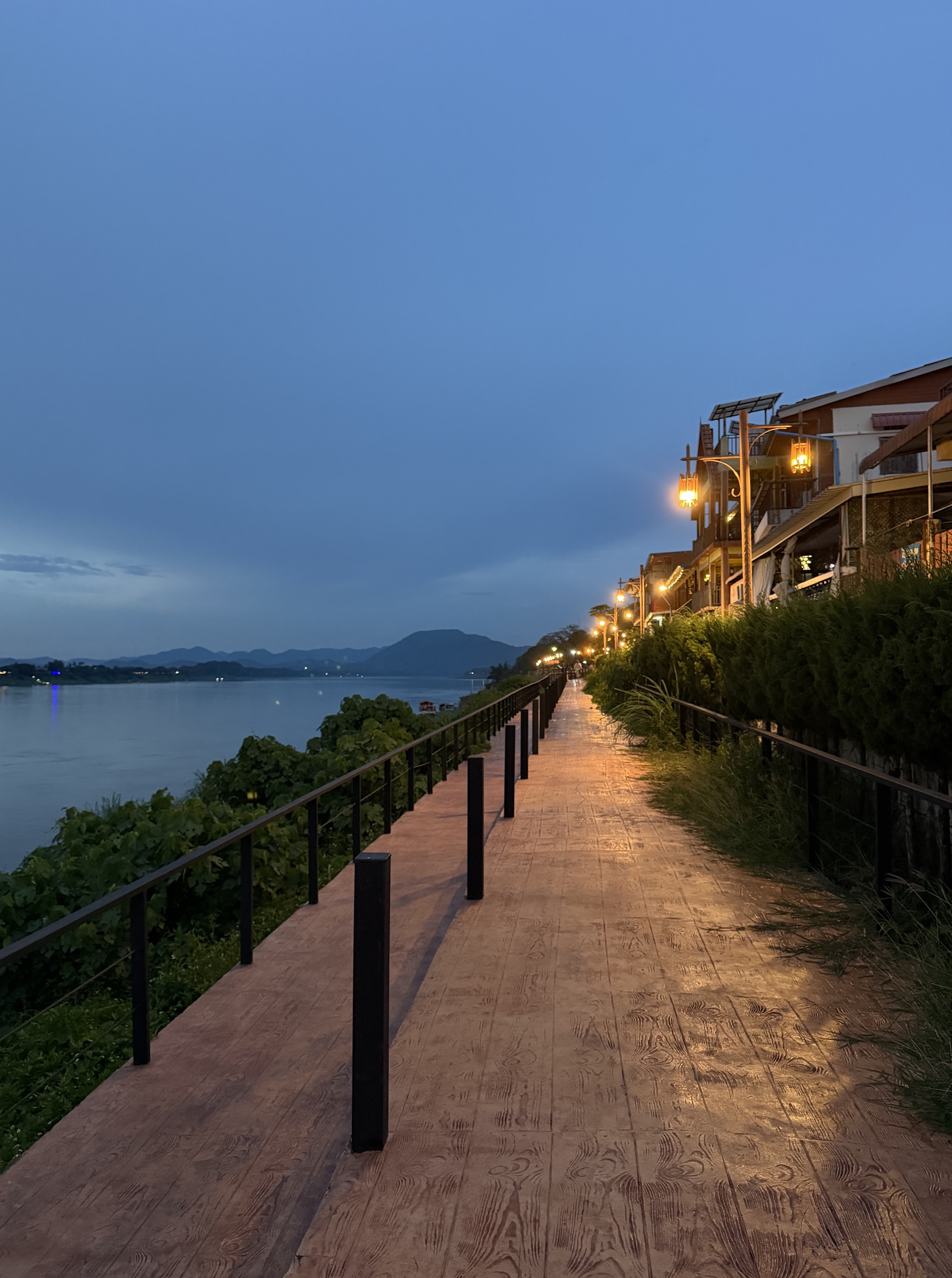
That evening, I walked along the river road before sunset. Wooden houses faced the Mekong. Tourists moved slowly between shops. A woman swept the front of her store. Somewhere a radio played an old song I did not recognize. The air had softened. The opposite bank darkened by degrees.
I thought of the woman in the white mask. I thought of the boy lifting his ghost face to check the world beneath it. I thought of the old man sitting beside his painted double. I thought of the masks hanging in the side street, turning slowly in the wind as if listening to something just beyond hearing.
The festival had given me no answer. It had done something better. It had made the question more precise.
What is hidden beneath the face I call myself?
The question did not arrive dramatically. It did not strike me like thunder. It moved quietly, like the river, and by the time I noticed it, it had already entered the room.
That night, back at the hotel, I found a small insect circling the bathroom light. It flew in uneven loops, struck the wall, recovered, and returned to the brightness. A few days earlier, in Singapore, I had sealed my apartment against creatures like this. Rat poison. Gecko traps. Insecticide at the windows. I had imagined myself keeping disorder outside. But beside the Mekong, after watching ghosts dance through Dan Sai, the insect seemed less like an intruder than a messenger from a smaller, more persistent world. A very small messenger, admittedly, and not an especially competent one.
It kept flying toward the light.
There was no wisdom in it, no metaphor it had agreed to carry. Yet I could not stop watching. Its tiny body repeated the same impossible movement: collision, recovery, return. It did not understand the bulb. It did not understand glass. It did not understand the room, the river, the border, the festival, or the man watching it from the doorway. Still it moved toward brightness with a faith more physical than thought.
I switched off the bathroom light.
For a second the room went completely dark.
Then the river entered through the window.
Not literally. But the darkness changed shape, and in that change I became aware of the Mekong outside, moving beyond the hotel, beyond the road, beyond the sleeping town. I opened the window slightly. Night air came in, carrying the smell of water and distant cooking smoke.
Somewhere across the river, a dog barked once.
Then silence.
I placed the strip of painted cloth inside my notebook.
The next day I would travel back to Loei, then Bangkok, then Singapore. I would unlock my apartment and find everything almost exactly as I had left it. The refrigerator would still hum. The traps would still wait behind the refrigerator. The city would continue speaking in its clean metallic language. Emails would return. Messages would return. The face I wear in ordinary life would return and settle itself over me with practiced ease.
But something else would return too.
Not knowledge. Not even memory exactly.
A mask, perhaps.
Or the space behind a mask.
That is the part I want to remember: not the colours, not the photographs, not the convenient explanation of an old festival, but the brief interval when the face became uncertain. The moment when ghosts walked through an ordinary town and nobody seemed afraid. The boy dancing badly and beautifully. The old man beside his painted double. The woman in the white mask who was there, and then was not. The river carrying all of it past the border without comment.
When I finally slept, I dreamed of my apartment.
In the dream, I opened the door and found the rooms filled with masks. They hung from the ceiling fan, rested on the sofa, leaned against the kitchen cabinets, sat in pairs along the floor. None of them moved. The refrigerator hummed. The insecticide smell remained in the air. From behind the refrigerator came the faint sound of bells. Even in the dream, I remember thinking that the pest-control situation had escalated beyond my original plan.
I woke before morning.
For several seconds I did not know where I was.
Then the Mekong appeared slowly in the window, grey and patient beneath the first light.
Across the river, Laos was still there.
Close enough to see.
Too far to touch.

